 Built In Oasis


DealForge (Real Estate ROI Calculator)
In DevelopmentStrategy-based real estate deal-analysis SaaS that models rentals, flips, BRRRR, and creative-finance deals in minutes.
An autonomous freight brokerage that models the freight market as a probabilistic graph and runs loads end-to-end under a governing AI control layer.
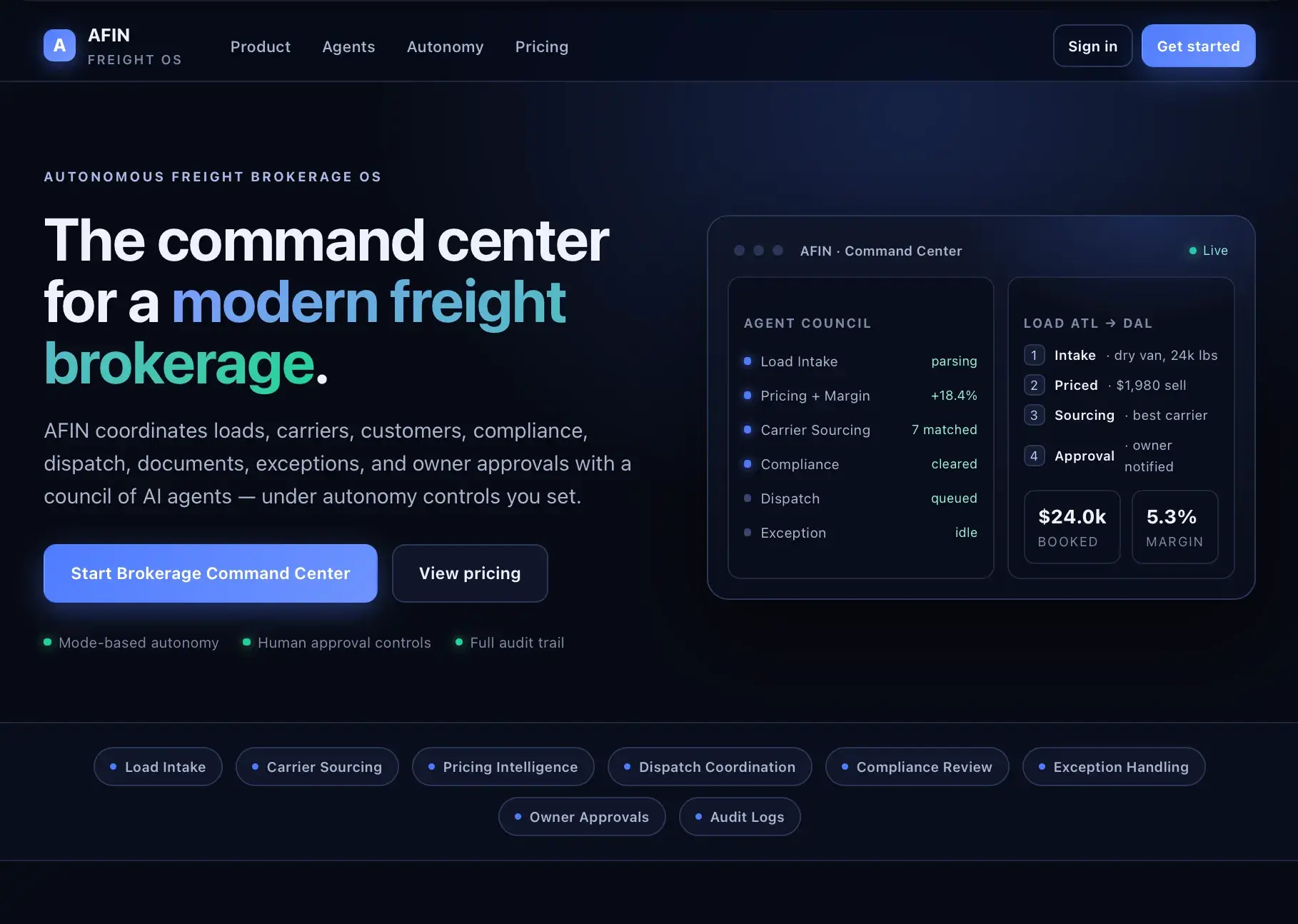
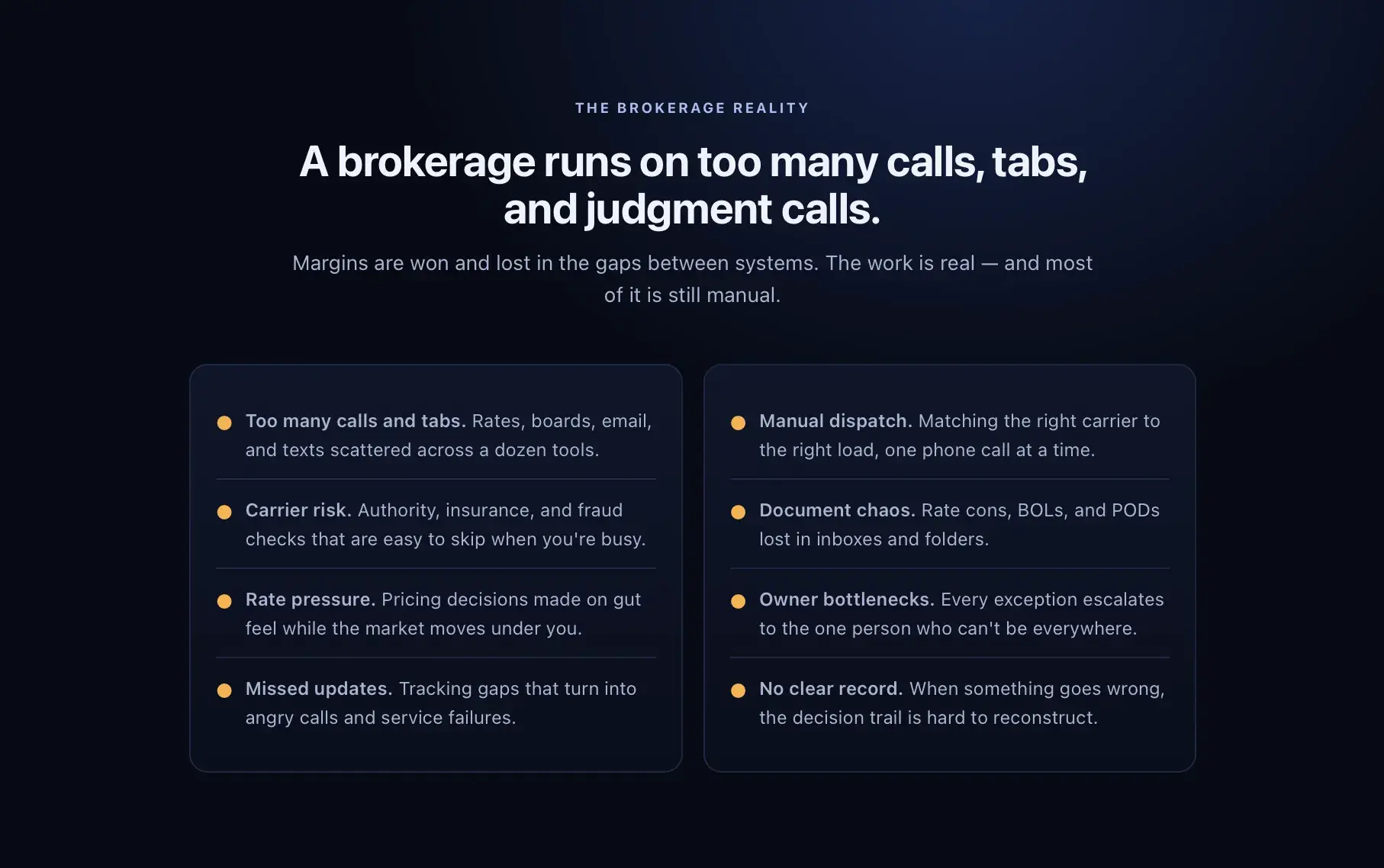
Freight brokerage is a fragmented, manual business: demand arrives as unstructured noise across emails, load boards, spreadsheets, and phone calls, while matching, pricing, negotiation, dispatch, and settlement happen across disconnected tools and human judgment. Local optimization of individual deals leaves system-wide profit, reliability, and risk unmanaged. Fraud, compliance failures, and mid-transit disruptions are caught late, if at all.
Built for Freight brokerages and logistics operators seeking to automate load acquisition, carrier matching, pricing, and settlement.
AFIN models the freight economy as a continuously evolving, event-driven graph of loads, carriers, lanes, shippers, and shipments. A set of specialized engines handle load acquisition, market intelligence, carrier intelligence, pricing and margin optimization, negotiation, dispatch, tracking, risk and compliance, and financial settlement. A Master Control orchestration layer governs which engine acts and resolves conflicts under a fixed hierarchy of safety over financial accuracy over optimization over speed, with graduated autonomy from manual to fully autonomous. The system boots through a defined activation sequence, proves the flow with an end-to-end demo that carries a load from acquisition through settlement, and handles fraud-detection, disruption self-healing, and global risk-override scenarios. State is durable via SQLite, and external services sit behind adapter interfaces with offline mocks so the core runs fully offline on deterministic formulas.
It proves a multi-engine autonomous system with a real orchestration layer that sequences subsystems and resolves conflicts deterministically, plus a spec-driven boot sequence with a pre-activation health gate that routes to a safe mode on failure. The domain logic is implemented as pure deterministic formulas (pricing, matching, trust, financial) with an extensive test suite, and external integrations (carrier registry, load board, telematics, payment rail) live behind swappable adapter interfaces with money-moving operations double-gated. It also layers on multi-tenant SaaS workspaces, subscription billing, an optional real-LLM reasoning path, and notification delivery.
Most logistics systems manage freight as a workflow. AFIN treats it as a probabilistic market graph and brokers it autonomously — acquiring, pricing, negotiating, dispatching, and settling loads end to end.
Load Acquisition & Demand Ingestion
Sources loads from the board and ingests demand into the market graph.
Market Intelligence & Prediction
Multi-horizon price forecasting with seasonality, macro, and competitor modeling, arbitrage, and lane positioning.
Carrier Intelligence & Supply Graph
Carrier-lane run history, capacity density, availability forecasts, reliability scoring, and empty-mile optimization.
Pricing & Margin Optimization
Risk-adjusted, capacity, and time-decay pricing pipeline with closed-loop error calibration.
Profit Surface EngineProfit-optimal bidding
Samples bid, probability-of-accept, and expected profit, then returns the expected-profit-optimal bid.
Lane Strategy Engine
Chooses penetration, margin-maximization, or balancing posture per lane.
Negotiation & Communication AI
Autonomous negotiation loop with strategy selection, sentiment inference, and deterministic message transcripts.
Route Optimization
Optimized route plans with ETA and time-window feasibility checks.
Dispatch & Execution
Route, time-window, and risk-gated carrier assignment, re-dispatch, and delivery confirmation.
Tracking & Exception ManagementSelf-healing re-dispatch
Live shipment state, dynamic ETA, deviation detection, failure prediction, and a self-healing loop.
Risk, Compliance & Trust
Multi-dimensional risk, compliance validation, trust decay, and the transaction safety gate.
Fraud Detection
Detectors for double brokering, fake identity, stolen authority, ghost shipments, and rate manipulation.
Financial Settlement & Profit Intelligence
True-cost reconciliation, realized-vs-predicted margin, anomaly detection, and system financial health.
Invoice Generation
Shipper invoice, carrier payment statement, and broker-fee breakdown.
Payment Processing
Carrier payment, shipper collection, escrow release, and cash-flow health.
Master Control OrchestrationGlobal risk override
Governs conflict resolution, resource allocation, autonomy gating, and the global risk override.
Integration Gateway
Adapter seam for load boards, carrier registry, ELD telematics, and payment rails behind clean interfaces.
Global State Memory Engine
Durable system-of-record state, audit, and global-state snapshot behind one repository interface.
Transaction safety
Payment-delay history and financial exposure of the counterparty.
Execution reliability and delivery risk indicators.
Insurance, authority, HOS, and equipment validation status.
Aggregate signal across the five fraud schemes.
Trust-graph anomalies and reputation shifts.
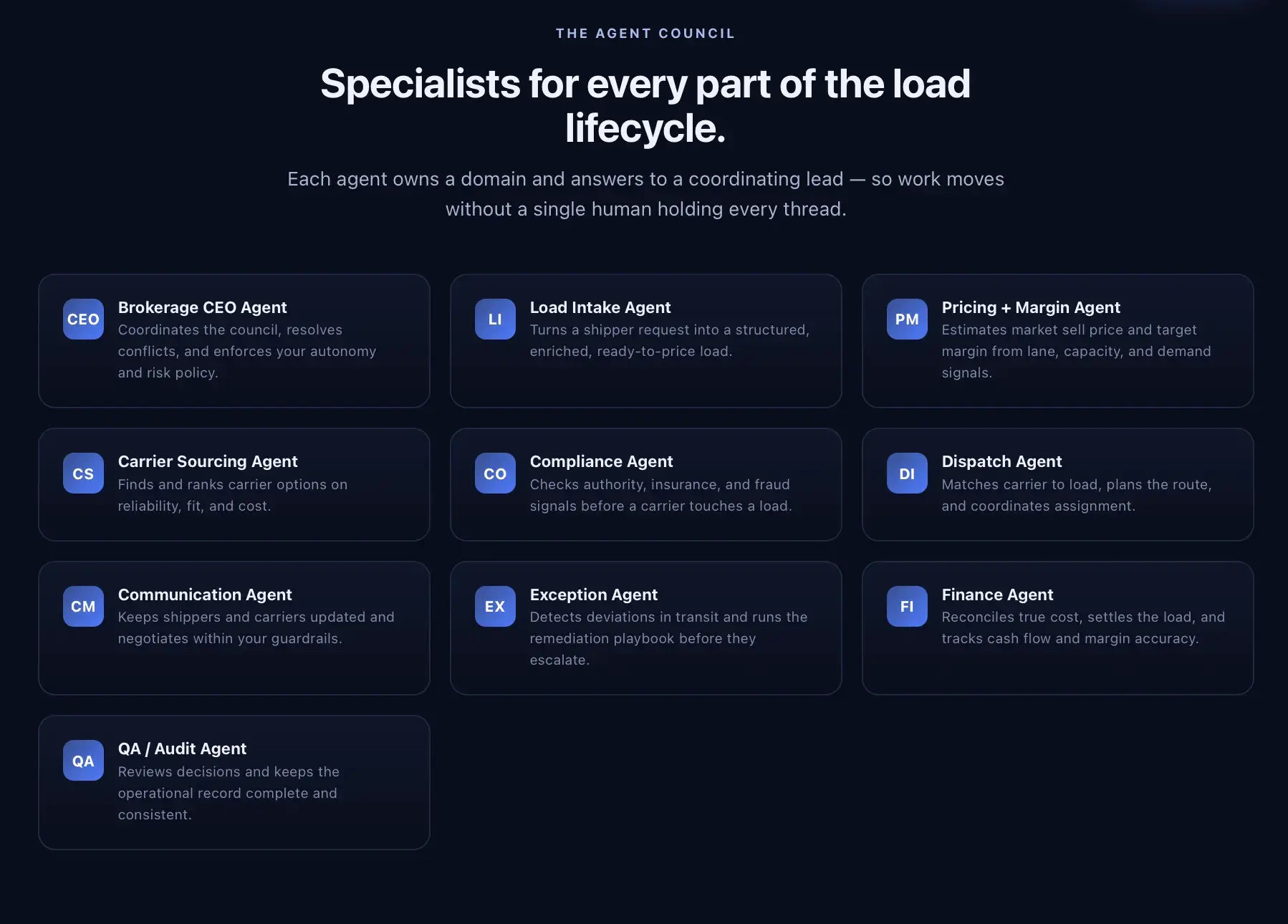
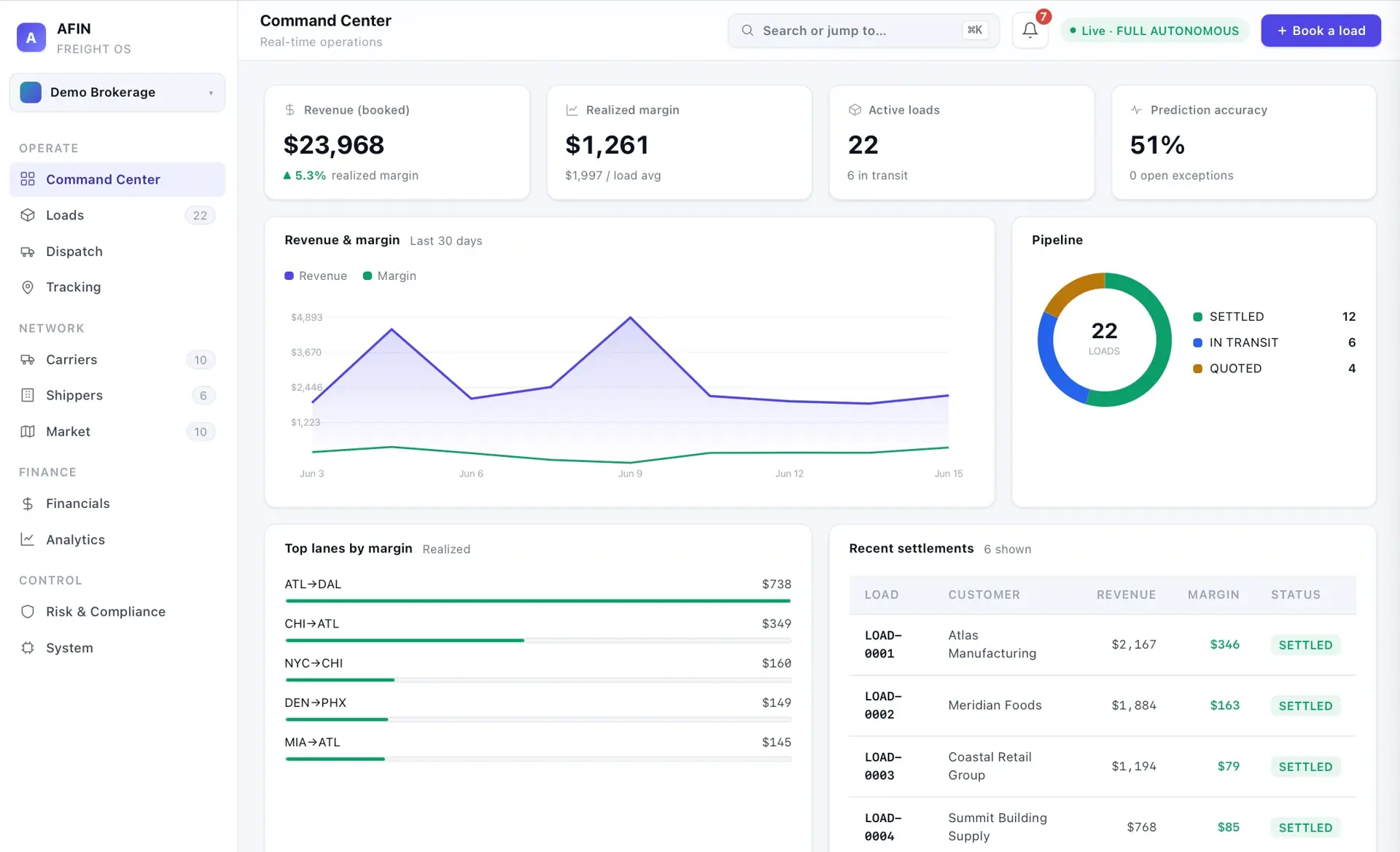
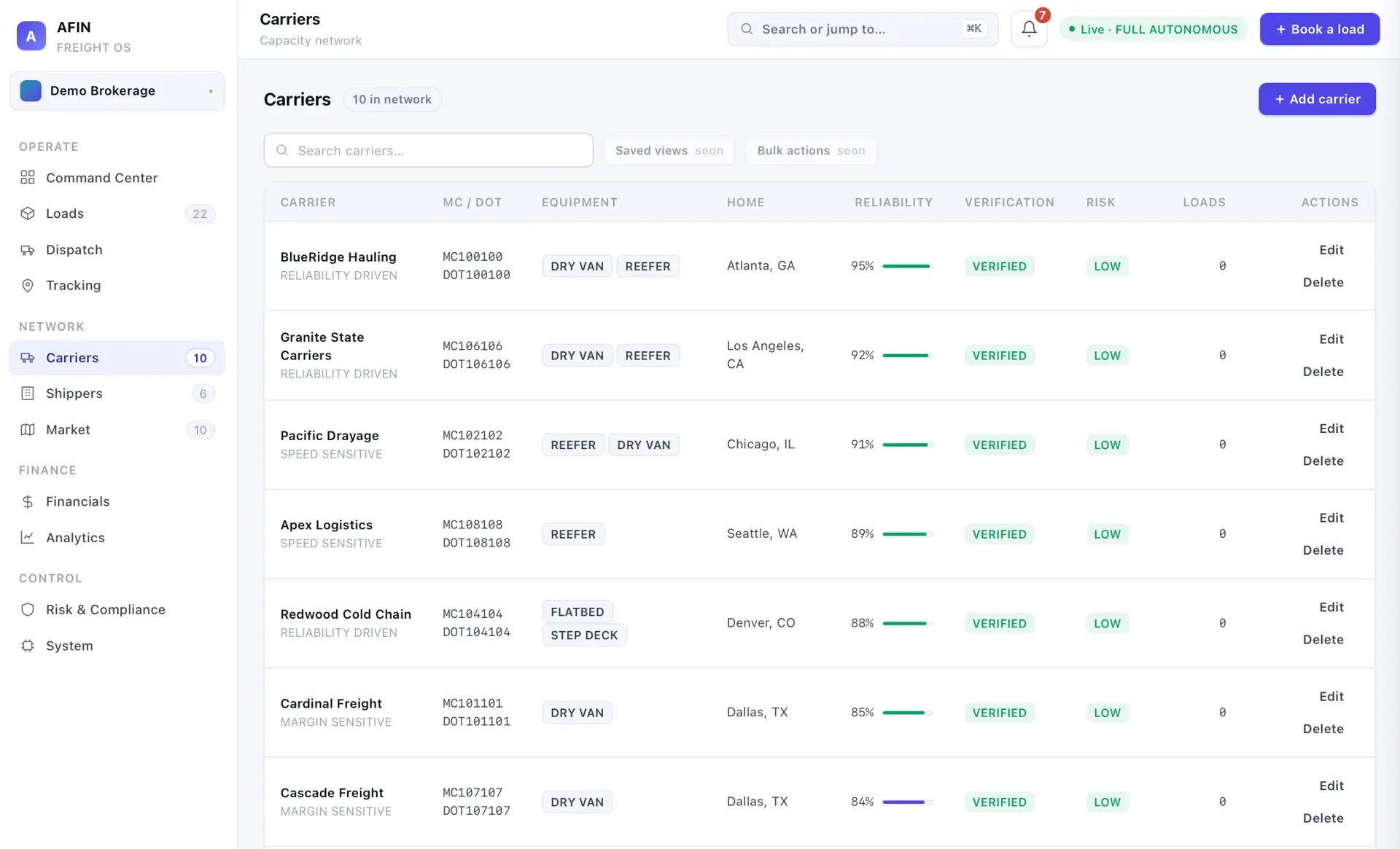
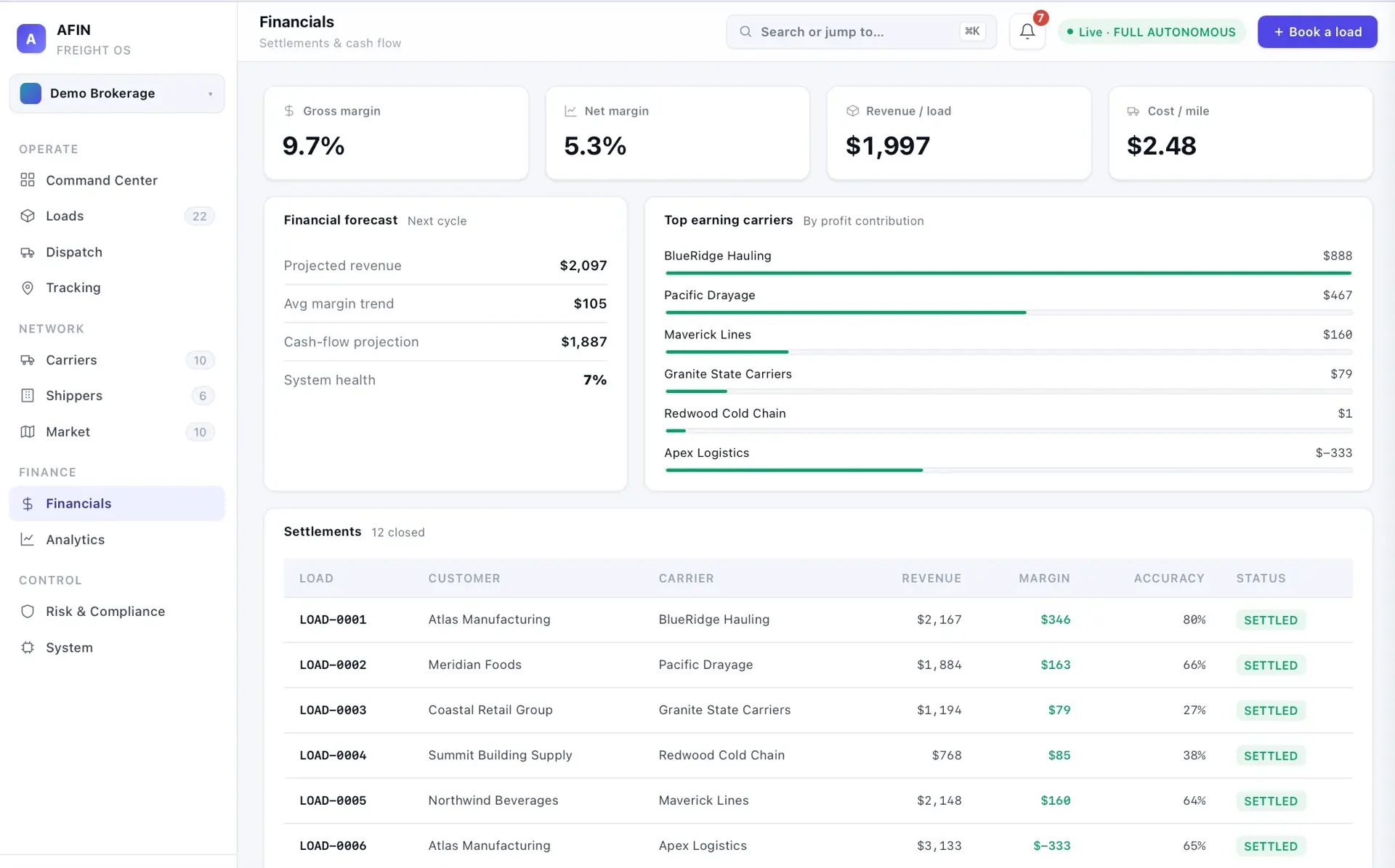
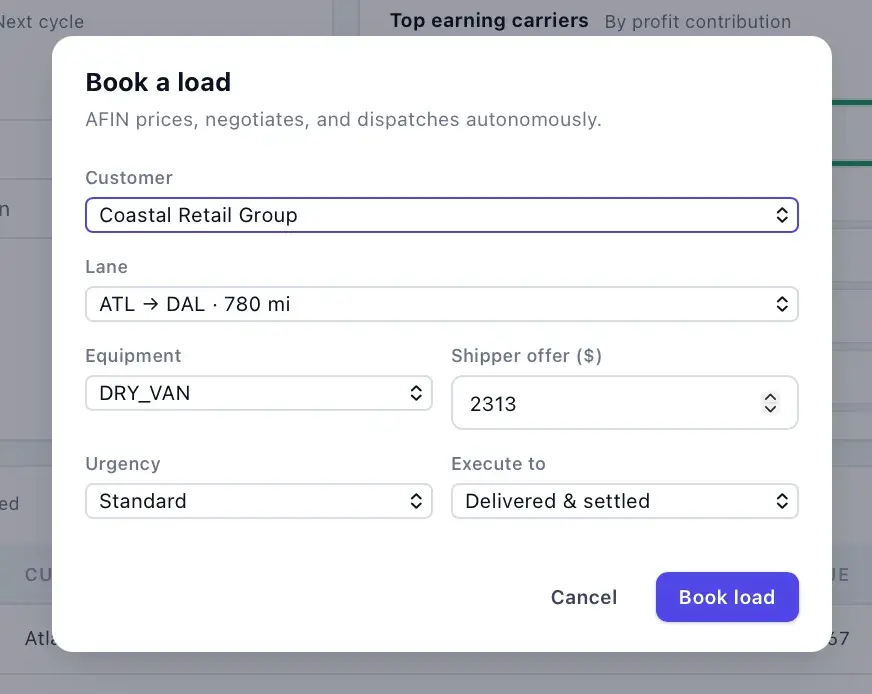
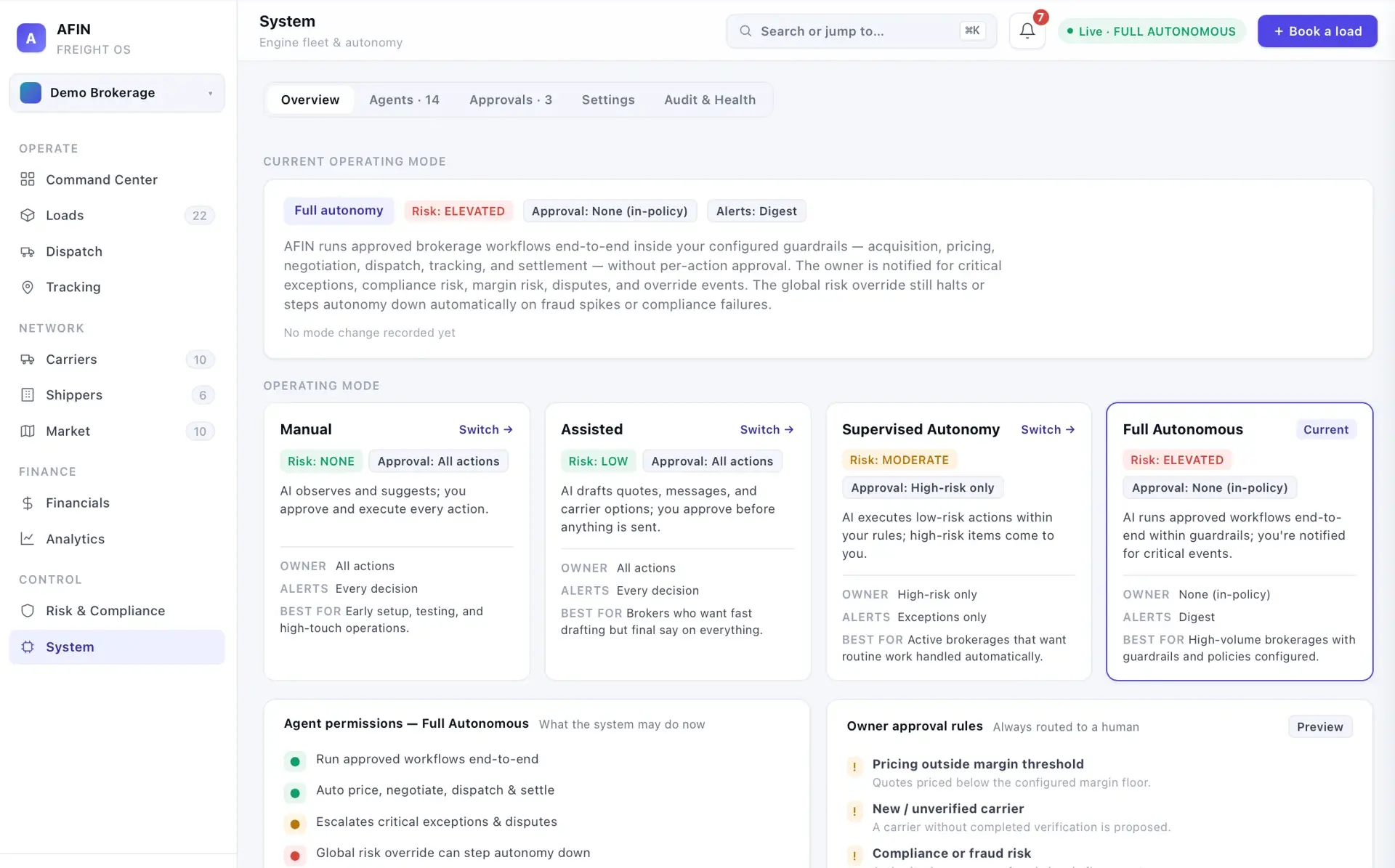
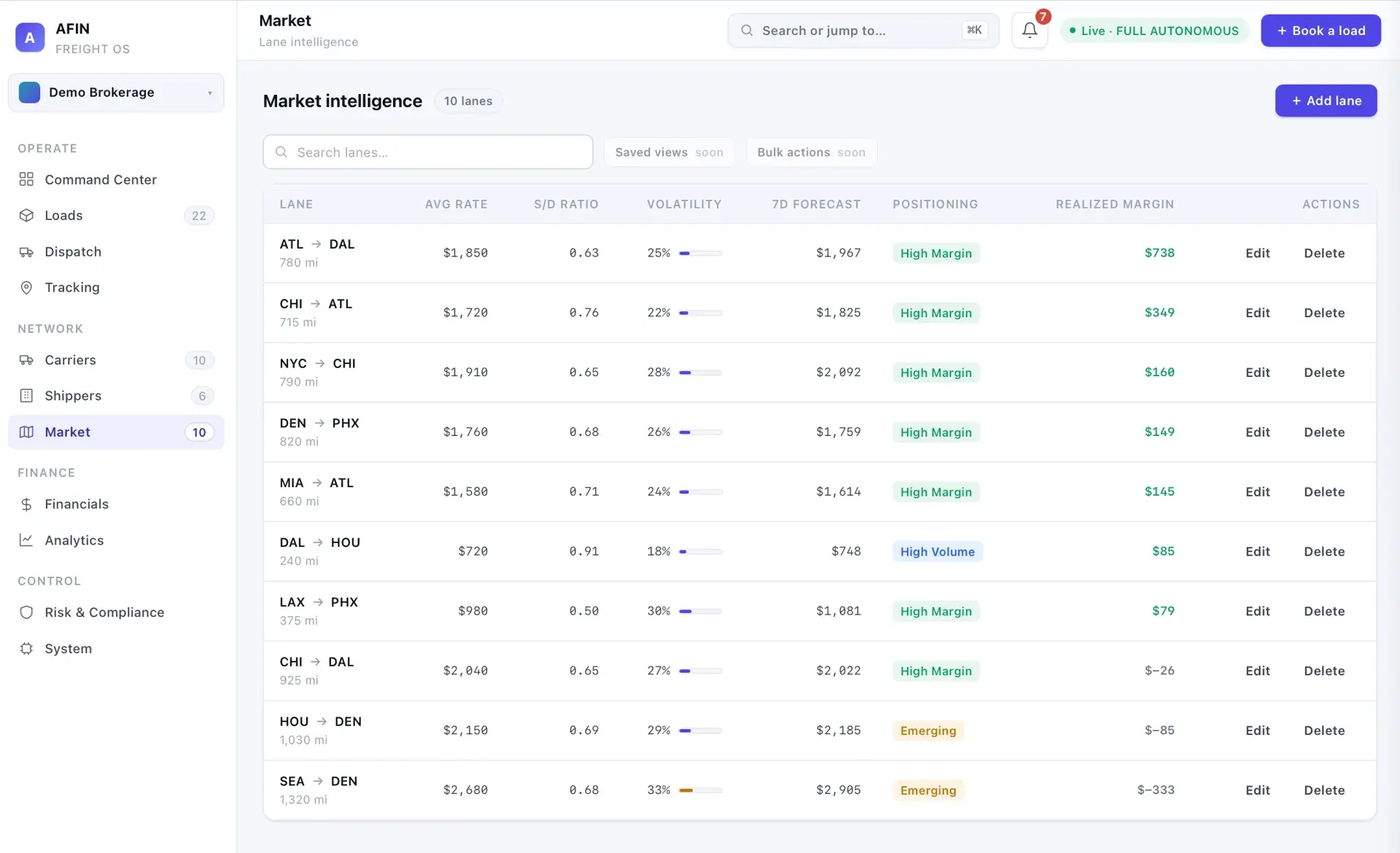
The backend is a Python/FastAPI application whose lifespan boots the engine system to an active state; domain entities are Pydantic models and persistence is a repository interface backed by SQLite (or PostgreSQL via a DATABASE_URL). Engines are separate modules coordinated by a Master Control layer, with external services abstracted behind adapter interfaces that default to offline mocks. A lightweight static frontend provides marketing, sign-in/up, onboarding, and app pages, and the whole stack is containerized with Docker.
Strategy-based real estate deal-analysis SaaS that models rentals, flips, BRRRR, and creative-finance deals in minutes.
Insurance supplement management for roofing contractors, with adjuster communication and AI.
An AI acquisition-intelligence platform that surfaces and scores off-market acquisition targets from public business signals.
Start a project and reference this one — the conversation begins with what you have already seen.
Start a project